

There's a moment early in Resident Evil Requiem where Grace Ashcroft — FBI analyst, decidedly not a soldier — finds a handgun in a locked hotel office and holds it like it might bite her. Her hand is shaking. She's been in the Wrenwood Hotel for maybe twenty minutes and she's already running from something she doesn't understand, in a building where her mother was murdered eight years ago.
It's a small moment. But it tells you everything about what kind of game Capcom built with the ninth mainline Resident Evil — and why it mostly works.

Resident Evil Requiem: Fear Has a New Face, and Her Name Is Grace
Requiem splits its campaign between Grace Ashcroft and Leon S. Kennedy, alternating between them across shared locations. Grace covers the horror half. Leon covers the action. On paper it sounds like a hedge — a studio uncertain which mode its audience actually wants. In practice, it's the smartest structural decision Capcom has made since RE7.
Grace is a protagonist defined entirely by what she lacks. She's not trained for this. Every resource decision matters because she has almost nothing. The primary stalker enemy — a creature that can't be killed, only avoided, only temporarily held back by light — is one of the most effective horror constructions in years. You learn to hear it before you see it. You learn which rooms have corners and which don't. The fear is earned through repetition and consistency rather than jump scares, and it holds up across the full runtime in ways that most horror game antagonists simply don't.
Then Leon shows up. He's 51 now, weathered and dry, carrying the weight of someone who's survived too much to be rattled by anything the Wrenwood throws at him. Nick Apostolides plays him with restraint rather than heroics — it's a good performance in a role that could easily tip into self-parody. His toolkit draws from the RE4 Remake's combat confidence: more weapons, higher mobility, and the enemies that were survival puzzles as Grace become clean, manageable engagements.
The first time you walk back through a room you spent an hour surviving as Grace and clear it in two minutes as Leon is the best single moment in the game. Both halves earn it.

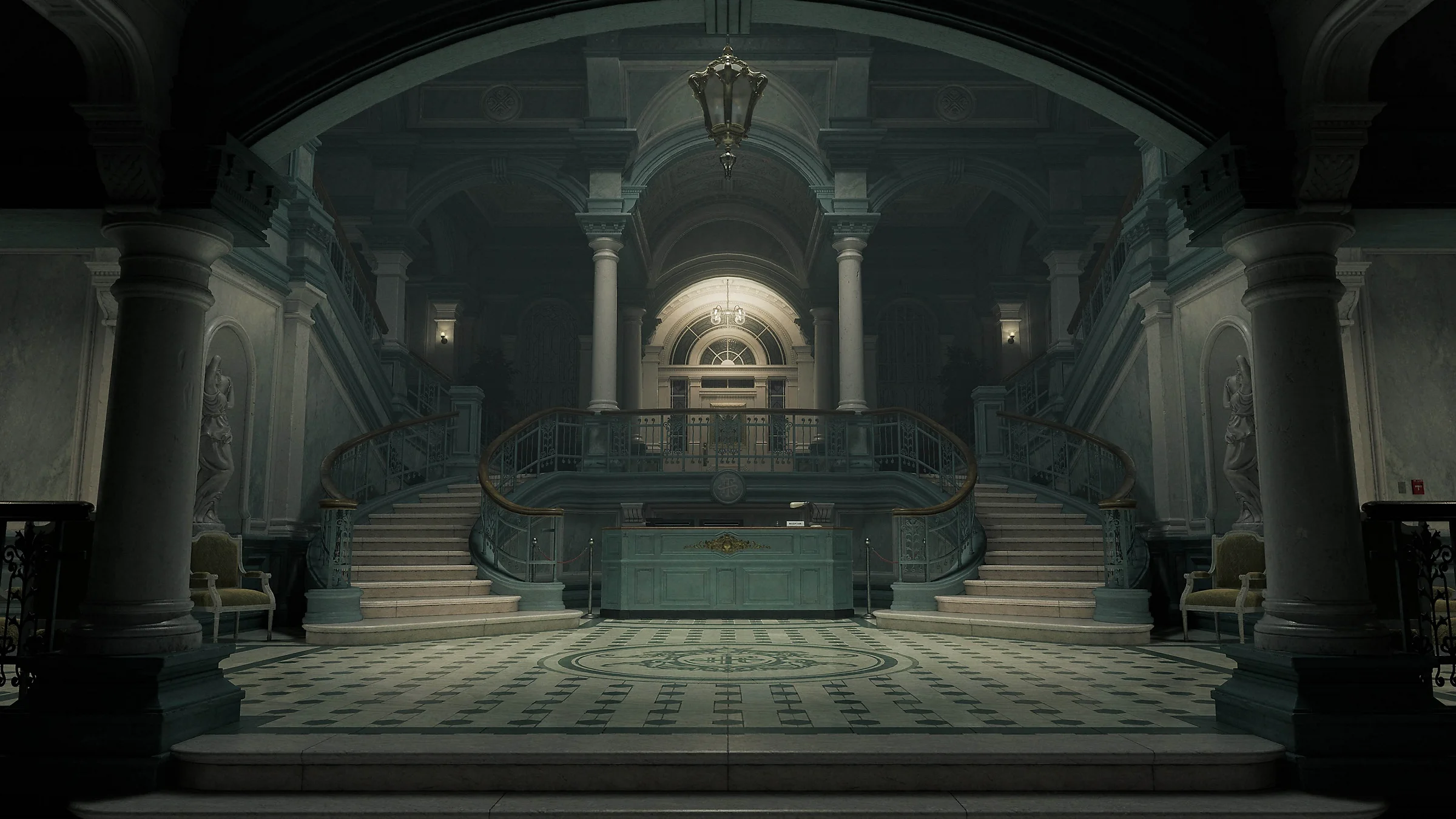
The Wrenwood Hotel: Resident Evil's Best Location in Years
The Wrenwood Hotel is a genuinely great Resident Evil location. It loops and interconnects the way the classic games did — blocked doors becoming throughways, rooms carrying physical traces of the other character's visit. Opened drawers. Enemy bodies. A puzzle already solved. It builds a layered sense of shared history without a single line of exposition.
Later sections open into broader environments — a care center, then Raccoon City itself — but the hotel is where Requiem is most sure-footed. The sound design does particular work here. Distant footsteps. Structural groaning. The way the stalker moves through darkness with that specific, unhurried weight. Capcom's audio team understood that silence is a tool as much as the score is, and they use it precisely. When nothing is moving, you're still listening. That's what good horror sounds like.
Angela Sant'Albano's motion capture performance as Grace anchors all of it. This is a protagonist who reads as physically real — not a character type, an actual person who's frightened and trying not to fall apart. The RE Engine renders her close-up expressions with the kind of fidelity that makes the writing's emotional intentions land rather than float.
Grace's Lighter vs Leon's Revolver: Two Ways to Survive
The biggest mechanical addition in Requiem is the ability to toggle between first-person and third-person perspective at any point — a first for a mainline Resident Evil game. Both modes are built around specific characters and intended experiences. Grace's sections were designed for first-person. The narrowed field of view amplifies claustrophobia. The inability to see what's directly behind you generates a sustained low-level anxiety the game exploits consistently and well. Leon's sections work best in third-person, where spatial awareness matters and combat legibility is essential.
Grace's blood collector mechanic adds a lightweight crafting layer that never tips into management busywork. Resources stay scarce without feeling arbitrary — you're consistently a few items short of comfortable, which is exactly where a Resident Evil game should position you.

The real payoff, though, is the contrast between the two toolkits. The stalker that made Grace's section terrifying — the one whose routes you spent hours learning, whose patterns kept shifting just enough to keep you honest — is something Leon can simply bully into a corner with his expanded arsenal. That tonal inversion between the two characters is the game's best trick, and it earns its payoff completely.
Victor Gideon and the Franchise Baggage That Catches Up
The boss fights are the most consistent frustration, and the criticism is fair. There are too few of them, they end quickly, and several that the game frames as major confrontations are over before the weight of the moment has time to register. Victor Gideon's own final confrontation is the clearest example — a fight the story spends its entire back half building toward, against a villain the game has taken real care to make feel dangerous, and it's resolved in a fraction of the time the buildup earns. Leon's revolver makes short work of what should be the game's heaviest moment. For a game this precise in its horror craft, it's a strange blind spot — a reminder that Resident Evil still hasn't fully solved the problem of making bosses feel proportionate to the dread that precedes them.
The back half also accumulates franchise baggage it can't fully repay. Victor Gideon is an unsettling villain in his early appearances — clinical, ideologically coherent, threatening in ways that don't rely on spectacle. Then the third act starts pulling in 30 years of Resident Evil continuity, and he gets lost in it. The story earns its emotional ending. The logic getting there is shakier than it needs to be, and players without deep franchise history will feel the gaps.

Puzzles are lighter than classic RE entries — noticeable if you came specifically for that, a non-issue if you didn't. And there's no Mercenaries mode at launch, though Capcom has confirmed a combat mini-game, photo mode, and story DLC in active development. The post-launch road looks healthy. It just isn't here yet.
Resident Evil Requiem: The RE Engine's Finest Hour
One thing with no asterisks: Resident Evil Requiem is the RE Engine's most impressive deployment, and the RE Engine was already the best-looking engine in survival horror. Character rendering — skin translucency, hair physics, micro-expressions — is at a level that makes the gap between cinematics and gameplay essentially invisible. The lighting in Grace's sections, where her lighter flame interacts with environmental shadow in real time, is the kind of thing you stop and watch even when something is trying to kill you.
On PC, full path tracing is available — the first Resident Evil game to support native path tracing. The visual improvement over standard lighting is incremental rather than transformative, and the performance cost is steep on mid-range hardware. Without path tracing, the game is well-optimized and runs cleanly across a wide hardware range. The launch was notably stable across all platforms — Capcom shipped this game in a clean state, which in 2026 is worth saying plainly. Commercially, Requiem hit 5 million units sold within its first five days — the fastest any mainline Resident Evil has moved that number — and has since crossed 6 million. It sits at 96% Overwhelmingly Positive on Steam across a large and growing review base. The reception makes sense: the game earns much of the praise it has received.
Resident Evil Requiem: A New Fear Walks Into the Building
By the time Grace and Leon's paths fully converge, Requiem has done something few long-running franchises manage this late: it's introduced a protagonist who feels essential to the series' future rather than a one-game experiment. Whatever Capcom does with the confirmed DLC and Grace's future in the series, the ending sets it up without over-explaining it.

Pros & Cons
What Works:
Grace Ashcroft is the franchise's best new protagonist in years
The stalker enemy is one of the most effective recurring horror threats in recent memory
The Wrenwood Hotel is Resident Evil's best-designed location since the Spencer Mansion
Genuine tonal contrast between Grace's horror and Leon's action, rather than a hedge between the two
RE Engine's most impressive deployment yet, with native path tracing on PC
Clean, stable launch across all platforms
What Doesn't:
Boss fights are too few, too brief, and don't match the tension built up around them
Third act leans hard on 30 years of franchise continuity, losing Victor Gideon in the process
Puzzles are lighter than classic entries
No Mercenaries-style mode at launch
What's Coming:
Photo mode (already added post-launch)
A minigame confirmed by director Koshi Nakanishi
A story DLC expansion, currently in development with no release window yet
TheCoreGamer | Staff Review
The Verdict
Capcom took the biggest structural gamble in Resident Evil's history with Requiem and landed it. Grace Ashcroft is the best new protagonist this franchise has produced in years, and the Wrenwood Hotel is the best location it's built since the Spencer Mansion. The dual-protagonist structure works not because the two halves balance each other out but because they genuinely contrast — Grace's sections make Leon feel powerful in ways he hasn't in years, and Leon's sections reframe everything Grace survived into something almost absurd. The boss fights are too brief and the third act fumbles its villain. Neither issue comes close to undermining what Capcom built here. Requiem's real achievement is proving that fear and power can sit inside the same game, told through the same story, without either one cheapening the other — and that's what makes this the most creatively alive Resident Evil has felt in over a decade.
Resident Evil Requiem
Available at Steam
↗ Affiliate link — we may earn a commission at no extra cost to you. Learn more
Related Tags